
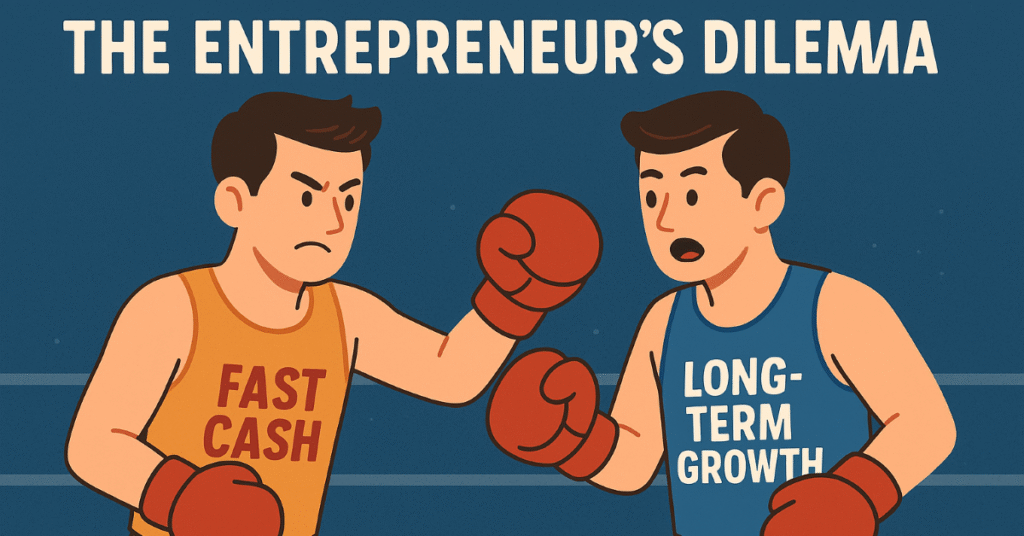
The Entrepreneur’s Dilemma: Fast Cash vs. Long-Term Growth
In this post, I discuss the tug-of-war many entrepreneurs face between focusing on strategies that generate quick online income versus those that yield long-term results. I’ll also explain the pros and cons of each approach.
I thought of this topic because lately, I’ve been feeling impatient. This summer was slow because I was setting up my new TikTok account and learning new skills, such as recording and editing videos. This took time away from other money-making activities outside of creating posts.
This impatience has also led to a sense of urgency that leaves me conflicted about what activities I need to do immediately to get back on track to make money. As I reflect on this now, I realize it is a common dilemma that many entrepreneurs share. Maybe you have experienced it too, and have asked yourself this question:

Do I focus on direct sales activities to make money right now, or should I play the long game and build something that pays bigger dividends in the future?
This has been going through my mind a lot. Let’s explore these two paths: quick wins versus lasting growth.
There are two main approaches to selling products online.
- Direct Product Links- Selling straight from your posts or advertisements.
- Content & Asset Links- Building trust first, then selling later.
On the one hand, using direct product links can generate instant sales. The dream of “make money now” is always tempting. On the other hand, taking the time to build long-term assets, such as growing an email list, cultivating a loyal audience, and establishing trusted relationships, may not yield immediate results. However, it can facilitate compound growth, passive income, and long-term stability.
Let’s look at each one separately. For the sake of simplicity, I’ll illustrate how the two paths could work by utilizing social media posts.
The case for direct product links
Creating social media posts that promote a specific product and include a link to purchase it is the most straightforward way to make a sale. You present your offer to your audience, and if they’re interested, they make a purchase.
Why this approach works:
- Simplicity. Followers know exactly what you’re offering.
- Instant ROI tracking. Sales data tells you what’s working.
- Great for promotions. Ideal for launches, discounts, or trending products.
The downsides:
- Sales fatigue. Audiences tend to tune out if every post is a sales pitch.
- Short-term focus. A one-and-done sale doesn’t build long-term loyalty.
- Algorithm suppression. Platforms push down “ad-like” content. Many major social platforms do this, and an account can sometimes be banned. It’s happened to me, so I know that this is a real problem and content creators need to be careful about this approach.
The case for building long-term assets
The alternative is slower but strategic. Instead of chasing one-off sales, you build assets; things that bring value long after you hit “post.”
This means your posts focus on these elements:
- Making content that educates and entertains.
- Telling your audience to learn more about a topic by checking out one of your blogs, podcasts, or videos.
- Using a free lead magnet with valuable information to grow your email list.
- Asking people to follow or subscribe to your social media account.
Why this approach works:
- Builds trust. People see you as someone sharing valuable information, not just a seller.
- Creates leverage. Email lists and audiences are assets you own.
- Boosts engagement. Content posts are naturally more shareable.
The downsides:
- Slower payoff. Sales don’t roll in overnight.
- More moving parts. You need funnels, nurturing, and patience.
- Tougher tracking. Harder to measure which post “caused” a sale.
The emotional dilemma: pressure vs. patience
Every entrepreneur feels the pressure to “make money now.” That’s what makes direct product sales appealing.
In my career, I’ve experienced both. My first job after college was selling insurance. The organization taught the salespeople to build long-term relationships with “centers of influence”, which were usually professionals in other industries who could refer business to them.
Centers of influence took time to build, but there was a sense of urgency to sell and make money for the agency as soon as possible. There was definitely a tug-of-war dilemma; how do you sell quickly if the referral sources take a while to develop? You either got lucky and got something going in a short period of time, or you had to tap into another agent’s referral source to make it through until your own resources worked. Alternatively, the salesperson may have taken the initiative to advertise or explore other methods to generate leads and sales.
The reality was that many salespeople quit after the first few years; in fact, I believe the percentage was about 90%. It wasn’t a good long-term model. This was before social media and free traffic became viable business resources, so any quick traffic and sales usually came from advertising, which was expensive, especially for new salespeople with no prior experience in sales or marketing.
I joined several local networking groups and made cold calls to businesses. However, cold calling often led to burnout, and it was not enjoyable at all.
My patience eventually paid off. I successfully generated leads through my networking efforts and collaborated with other agents on joint projects, from which we both earned money from larger clients. I learned firsthand that short-term strategies can lead to burnout, fatigue, and dissatisfaction. Long-term strategies often require time and patience to reap the benefits of your labor fully.
Even seasoned entrepreneurs wrestle with this balance. Despite knowing that the long-term approach is more sustainable, the temptation for quick wins never seems to go away.
Everyone is in a different situation initially. Some have more experience than others. Some have more financial resources than others. For those that need to make money quickly, and therefore take the direct sales path, the problems of easy burnout and high failure rates persist.
One thing I have learned is that focusing on long-term strategies is the most effective approach. It is more fun and rewarding because the focus is on helping people solve problems. It also produces the best long-term yields and productivity.
The primary long-term growth strategy I utilize is called the 4 Core Area of Making Money:
- Driving traffic
- Capturing traffic
- Following up
- Making Offers
If you are new and seeing this for the first time, click here to read a blog post that explains this strategy. This approach has been a guiding light in my business ventures, and I really believe it is a valuable blueprint to use.
If you’d like another resource, I recommend reading a book from the person I learned this from, Dean Holland. It’s called The Iceberg Effect. I am happy to offer you a special discount to get the book for free, just pay a small shipping and handling fee by clicking here.
I’d love to hear from you:
👉 When you post on social media, do you lean more toward sharing direct product links for fast cash, or do you focus on building long-term assets like an email list?
Drop your thoughts in the comments below. Your perspective could help another entrepreneur who’s wrestling with the exact same decision.
And let me know if you have any questions!